
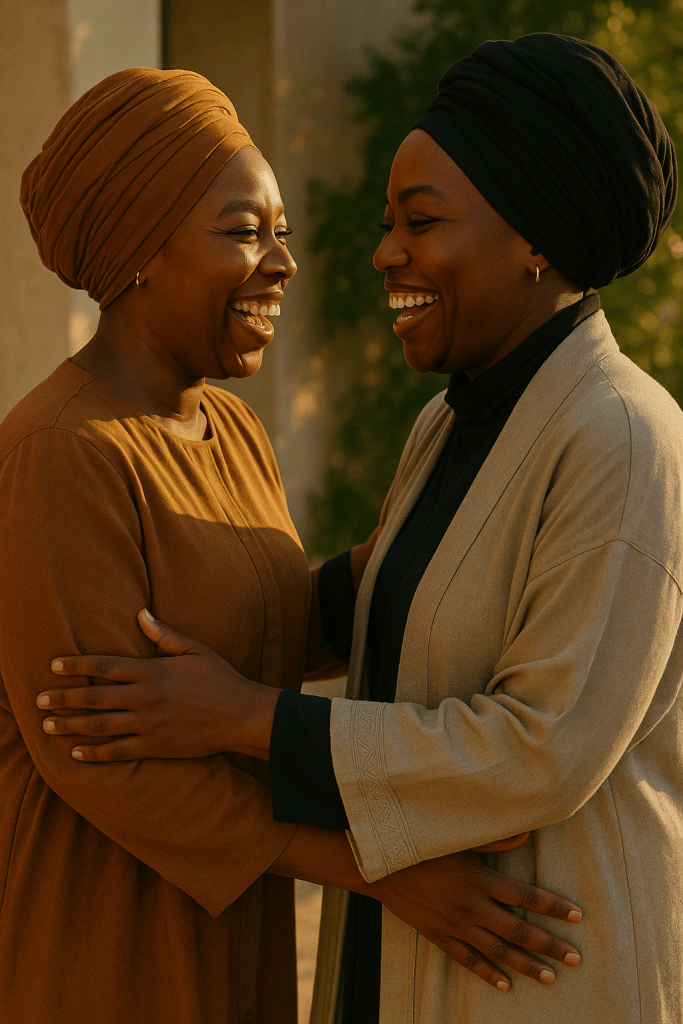
We as Muslim women from the community of Imam W.D. Mohammed often respond to a compliment from another sister with the phrase, “I am but a reflection of you, my Sister.” As I was reflecting on the beauty of how this display of sisterly affection always makes me feel uplifted, valued, and honored, I thought of the programming that Allah (swt) has instilled in each of us to soothe and heal ourselves and to affect others. At first, it may sound like a poetic expression of humility, but modern neuroscience offers a fascinating layer of truth to this spiritual wisdom.
The Science of Reflections
In the 1990s, neuroscientists discovered mirror neurons—specialized brain cells that fire not only when we perform an action, but also when we watch someone else perform it. When you see your sister smile, your mirror neurons light up as if you were smiling yourself. When you witness kindness, your brain rehearses kindness within you. In short, we are wired to reflect one another.
This means our moods, behaviors, and even spiritual states ripple through the bonds we share. When we uplift another woman, we also uplift ourselves. Saying “I am but a reflection of you” is not just courtesy—it echoes a neurological reality: we become what we witness in each other.
Bilqis and the Floor of Prophet Sulayman (peace be upon him)

The Qur’an gives us a powerful metaphor for reflection in the story of Bilqis, the Queen of Sheba. When she entered the palace of Prophet Sulayman (Solomon), she mistook the crystal floor for a body of water and lifted her gown to protect it. Only then did she realize she was seeing her own reflection in a surface clearer than she had ever encountered.
That moment was more than a physical reflection—it symbolized her awakening to a new way of seeing herself. Confronted with the beauty and purity of divine truth, she said, “My Lord, indeed I have wronged myself, and I submit with Solomon to Allah, Lord of the worlds.” (Qur’an 27:44, Surah An-Naml).
Just as mirror neurons allow us to absorb the best in one another, Bilqis’s reflection allowed her to recognize a higher version of herself. Through the light of Al Islam, she began to perceive her dignity, potential, and wholeness in a way she hadn’t before.
Reflections in Sisterhood
Every time we remind a sister that she is radiant, wise, or resilient, our brains don’t only affirm her value—they reinforce that same potential within us. This is the beauty of Muslim sisterhood: our words and actions create a cycle of mirrored growth.
So, the next time you tell a sister friend, “I am but a reflection of you, my Sister,” know that you are affirming both science and scripture. We are mirrors to one another, helping each other see light where we may have once seen shadows—just as Bilqis found her true reflection in the presence of truth.
May our reflections always guide us closer to Allah (swt) and remind us of the beauty we share.
Stay tuned for Dr. Farah’s upcoming book release exploring more topics in spirituality, science, and success!
